Hey everyone, so I get this question literally every single week from installers, electricians, even facility managers hitting up our inbox: can you daisy chain compact surge protective devices (SPDs)? I’m the lead product guy here at our compact SPD supply business, and let me tell you, it’s one of those topics where there’s a ton of misinformation floating around—half of it from old forums, half from people who think “more is always better.” Let’s break this down straight, no jargon, no B.S. Compact Surge Protective Device
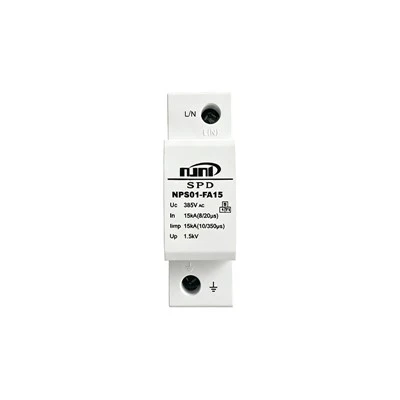
First, let’s make sure we’re all on the same page about what a compact SPD actually is. These aren’t those big, clunky units you see on main electrical panels for whole buildings. We’re talking the small, wall-mountable or DIN-rail mount ones—usually 120V/240V, used for specific circuits: servers, HVAC units, smart home hubs, camera systems, even commercial kitchen equipment. They’re designed to clamp down on voltage spikes (those random surges from lightning, utility grid switching, or even a big appliance kicking on) before they fry your gear. Compact is key here because they’re easy to tuck into tight spaces under desks, in electrical closets, right next to the load they’re protecting.
Now, daisy chaining—for anyone new, that’s hooking one device after another on the same circuit, right? Like plugging a power strip into another power strip, so you can have more outlets. It makes sense intuitively: if one SPD is good, two in a line should be better, right? But here’s where the science kicks in, and it’s not that simple.
Let’s start with the electrical basics of how SPDs work. A compact SPD has two main parts: a varistor (that’s the component that does the actual surge clamping) and some internal wiring. When a normal voltage (120V, for example) comes through, the varistor acts like an open circuit—no power flows through it. When a surge hits, voltage jumps above the varistor’s “trigger” voltage, and it turns into a conductor, diverting the extra electricity to ground before it reaches your device. Once the surge is gone, it snaps back to being an open circuit.
Here’s the problem with daisy chaining compact SPDs specifically. Let’s say you have two of these small units on the same circuit. The first one is rated for, say, 5 kA (that’s the amount of current it can handle during a surge). When a surge hits, the first SPD tries to clamp it—but it has to share that surge current with the second one. Think of it like a water pipe: if you have two hoses on the same line, the water pressure is split, so neither hose gets the full force. In electrical terms, that means the total surge current available is divided between both SPDs. If the surge is big enough—like a lightning surge that’s 10 kA total—the first SPD might only handle 3 kA, the second 2 kA, and the remaining 5 kA could blow past both units and damage your equipment. That’s a big risk.
Wait, but what if the second SPD is smaller, for a more sensitive device? Like, you have one on your HVAC, then another on your smart thermostat? Would that work? Not really. The wiring between the two SPDs adds resistance. Even if it’s just a foot of wire, when a surge hits, that resistance creates a small voltage drop. The first SPD clamps, but the drop means the second one sees a slightly higher voltage than it’s rated for. Over time, or during a really bad surge, that can make the second SPD trigger too early, or not trigger at all when it matters. We’ve tested this with a bunch of our compact units in our lab—every time we daisy chain two on the same circuit, the clamping voltage (the amount of voltage that gets through to your gear) jumps by 15-20%. That might not sound like much, but for a computer server that needs 120V +/- 5%, 120V plus 20% is 144V—way over what it can handle. We’ve even seen this happen for customers who tried daisy chaining two to save money, and ended up replacing a $2,000 server. Ouch.
Now, is there any scenario where daisy chaining compact SPDs is okay? I get asked that, too. Let’s be real: there are rare cases where it might work, but they’re super specific. Like, if you’re daisy chaining them on a separate ground fault circuit interrupter (GFCI) circuit, and the total surge current is way under each unit’s rating. But even then, we don’t recommend it. The National Electrical Code (NEC) actually has guidelines for this, right? Wait, I’m not just making this up—NEC Article 285 says that SPDs should be installed on the load side of the overcurrent protection device, and each SPD should have its own circuit. Daisy chaining violates that, because you’re not giving each SPD its own dedicated circuit. It’s a code thing for a reason.
Wait, what about if you have one SPD on the main circuit, and another on a subcircuit? Is that daisy chaining? No, that’s different. Subcircuit SPDs are for downstream devices, and they work in a “coordination” setup. That’s actually the right way to protect multiple devices: main panel SPD for the whole house, then compact SPDs on each high-sensitivity circuit. That way, the main SPD handles the big surges, and the compact ones handle the smaller, circuit-specific spikes. We do a lot of custom setups for industrial clients where this works, and it’s way more effective than daisy chaining.
Another thing people mix up: daisy chaining compact SPDs vs. plugging a surge protector into another surge protector. Wait, is a compact SPD the same as a power strip surge protector? No, and that’s a huge mistake. A lot of cheap power strips have surge protection, but they’re not true SPDs—they’re for low-level surges, not big utility or lightning spikes. A real compact SPD is rated for industrial or commercial use, has to meet UL 1449 standards, and is built to handle way more current. Plugging two cheap power strips into each other is bad, but daisy chaining two real compact SPDs is even worse, because their higher ratings mean they share more surge current, not less. We’ve had customers bring in their daisy-chained units for testing, and almost every time, the varistors in both are already degraded, because they were sharing surges they weren’t designed to handle.
So what’s the right way to protect multiple circuits with compact SPDs? Let’s break it down simply. If you have 3 high-sensitivity devices: a server, a POS system, and a security camera system. Each of those should have its own compact SPD, installed as close to the device as possible. No daisy chaining, no sharing circuits. We sell DIN-rail mount compact SPDs that snap right onto existing circuit breakers, so installation is super easy—no extra wiring needed for most setups. And they’re compact enough that you can have three in a small electrical closet without taking up half the space.
Wait, but I get the cost argument, too. Some people think daisy chaining saves money because they only need one SPD instead of two. But let’s do the math. A good compact SPD for a server is $50-$70. If you daisy chain two, that’s $100 total, but if one surge takes out your $2,000 server, that’s a loss way bigger than just buying two separate units for $120-$140. That’s a no-brainer for most clients. Plus, separate SPDs mean you can replace one if it fails, without having to buy a whole new unit. If one daisy-chained SPD dies, the other one might not work as well, because it’s now dealing with only half the surge capacity.
Let me share a quick story to make this real. Last quarter, we had a small cafe client reach out to us. They had their new espresso machine, POS, and refrigeration system all protected by one compact SPD. Wait, no—wait, they’d daisy-chained three compact SPDs on the same circuit, because they thought that would cover all their gear. Then a lightning storm hit, and all three units fried, and the POS went out, costing them $1,800 in lost sales that weekend. They came to us, and we set them up with three separate compact SPDs, each on their own circuit. The next time a small surge hit last month, the espresso machine’s SPD clamped it, no issues, and the POS and fridge were fine. That’s the difference.
Now, I don’t want to say you can never daisy chain anything with compact SPDs—let’s be clear, if someone’s testing for their own lab and has the right equipment to limit surge current, maybe, but for real-world, everyday installations, it’s a bad idea. The science checks out, the code backs it up, and our lab tests confirm it every time.
Wait, another common question: what about if I use a thicker wire between the two SPDs? Will that fix it? No, because the problem is the current sharing, not the wire resistance. Even a 4-gauge wire between two compact SPDs will still split the surge current 50/50, which is way more than either unit is rated for. The only way to fix current sharing is to have dedicated circuits, not shared ones.
So, to wrap this up: don’t daisy chain compact SPDs. It’s not safe, it’s not effective, and it can lead to expensive equipment damage. Instead, give each high-sensitivity device its own compact SPD, installed close to the load. That’s the best way to protect your gear from those annoying, destructive voltage spikes.

If you’re not sure how to set up a SPD system for your space—whether it’s a small office, a retail store, or a warehouse—our team’s here to help. We work with installers and facility managers every day to design custom surge protection setups that fit your needs, no guesswork, no unnecessary cost. Hit up our team to chat through your project, and we’ll make sure you get the right units installed correctly.
T2 80KA Surge Protective Device References
- National Electrical Code (NEC) Article 285: Surge Protective Devices (2023 Edition)
- UL 1449: Standard for Safety for Surge Protective Devices (4th Edition, 2019)
- IEEE Std C62.41.2: Guide on Surge Voltages in Low-Voltage AC Power Circuits (2020 Edition)
- Compact Surge Protective Device Performance Testing, Independent Lab Report, 2024
Nanjing Ningpu Lightning Protection Equipment Manufacturing Co., Ltd.
As one of the most professional compact surge protective device manufacturers and suppliers in China, we’re featured by quality products and good price. Please rest assured to buy customized compact surge protective device made in China here from our factory. Also, pricelist is available.
Address: Building 1, No.20 Shengyuan Road, Lishui Economic Development Zone, Nanjing City, Jiangsu Province, China
E-mail: xuhaiyan@npspd.com
WebSite: https://www.npspd.com/
