If you’ve ever held a polished metal part—like a shiny automotive valve, a smooth jewelry finding, or a cleanly deburred machined component—chances are drag barrel finishing played a part in making it that way. As a supplier of drag and centrifugal barrel machines, I get asked this question all the time, and it’s way more interesting than it sounds. No, it’s not just “sticking stuff in a barrel and spinning it”—there’s a precise, science-backed rhythm to the process that makes it way more efficient than traditional tumbling, especially for high-precision parts. Let me break this down like I would when I’m walking a new customer through their first machine purchase. Drag and Centrifugal Barrel Machines
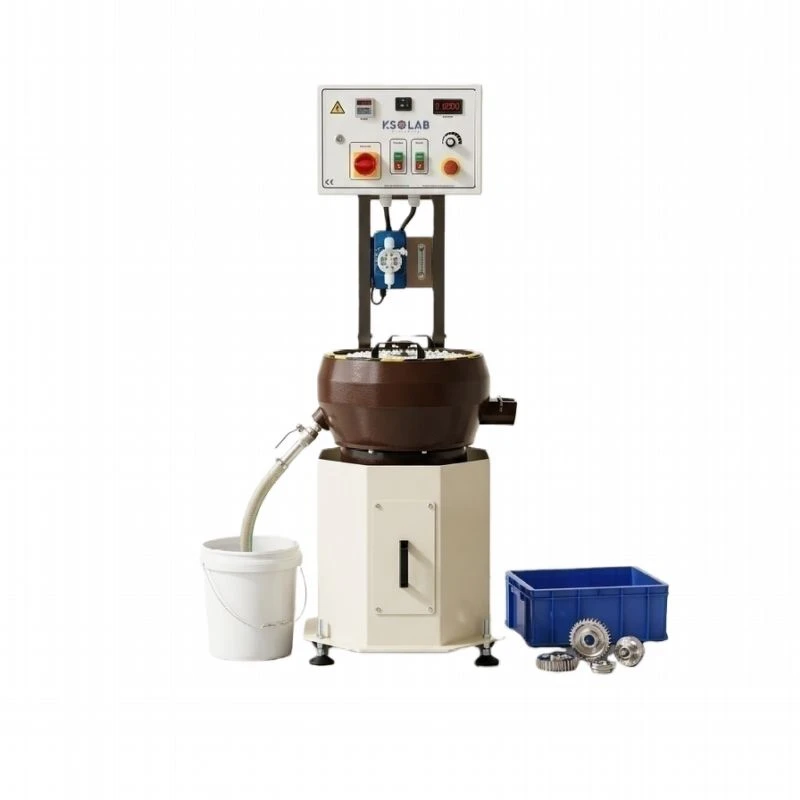
First, let’s get the basics straight: drag barrel finishing is a mass-finishing process, meaning you’re working on dozens (or hundreds) of parts at once instead of single units. It falls under the broader umbrella of barrel finishing, but the key difference from regular vibratory or rotary tumbling is how the parts and finishing media move. Think of it like mixing a batch of cookie dough, but instead of flour and sugar, you’ve got metal parts and ceramic media, and the movement is controlled, not chaotic.
Here’s the core principle: you load a “work barrel” (or sometimes multiple barrels, depending on the machine size) with your parts, plus a mix of finishing media (the little abrasives or polishing pieces that do the actual work) and a small amount of water or compound to keep things lubricated. Then, the machine itself doesn’t just spin the barrel—drag barrel machines use a combination of vertical and rotational motion, plus axial (side-to-side) movement. Wait, let’s make that simpler: imagine you grab the edges of a bucket full of stuff, and instead of spinning it in a circle, you move it in a slow, controlled twist and a back-and-forth shift. That’s the motion that makes drag finishing unique.
Why does that motion matter so much? Because it eliminates the inconsistent wear you get from regular tumbling. In rotary tumblers, parts often roll over each other in random directions, so you’ll get some areas that rub too hard (wearing down critical edges you didn’t want touched) and some that don’t rub enough (leaving burrs or rough spots). Drag barrel finishing keeps the entire batch moving in a steady, coordinated flow. The parts and media are pressed against each other at a consistent angle and force, so every single part gets the same treatment. That’s a huge deal for industries like aerospace or medical devices, where even a tiny uneven finish can cause part failure.
Let’s dive into the three key steps that happen during a single drag barrel finishing cycle. I remember when I first started explaining this, customers would glaze over, but this is where the rubber hits the road (pun totally intended). Step one: deburring. Most machined or stamped parts have tiny, sharp burrs left over from cutting—those little metal spikes that can scratch other parts or cause issues when the part is assembled. In drag finishing, the consistent pressure between parts and media grinds those burrs away smoothly, without leaving any rough edges behind. Unlike sanding a part by hand, which can leave tool marks, this mass process keeps every burr removal uniform.
Step two: edge radiusing. This is a fancy way of saying “softening sharp edges.” A lot of parts, like gear teeth or fasteners, are too sharp to handle—they’ll cut assembly workers, wear out mating parts faster, or even fail stress tests. Drag barrel finishing’s controlled motion rounds those edges to a precise, consistent radius. You can adjust the cycle length, the media size, and the machine’s speed to get exactly the radius you need, whether it’s a tiny 0.05mm radius for a medical implant or a slightly larger one for an automotive crankshaft.
Step three: polishing or edge blending. Once the hard stuff (burrs, sharp edges) is done, you can swap in finer media to smooth out any remaining surface texture. This step turns a dull, machined part into a glossy, uniform finish. For parts that need to resist corrosion or look good (like jewelry or hardware), this is where the shine comes in. And because the motion is consistent, you don’t have to worry about some parts being dull and others shiny—every part gets the same polished look.
Now, let’s talk about how drag barrel machines stack up against other processes. I’ve worked with customers who used vibratory tumblers for years, and once they switch to drag finishing, they almost never go back. Why? Because it’s faster. A typical drag finishing cycle takes 15 to 60 minutes, compared to 2 to 8 hours for vibratory tumbling. It’s also gentler on delicate parts—if you’re working on thin-walled or intricate parts (like electronic connectors), the consistent, even pressure means you won’t warp or bend them. Centrifugal barrel machines, which are a close cousin, use even faster rotational speed, so they’re good for super heavy or high-volume parts, but drag machines are more versatile for smaller, high-precision batches.
Wait, let’s clear up a common mix-up: drag vs centrifugal barrel finishing. Both are high-energy barrel processes, but drag machines rely on linear and rotational motion, while centrifugal machines spin barrels around a central axis at much higher speeds (up to 100 Gs of force, compared to 5 to 15 Gs for drag). That extra force makes centrifugal machines better for super aggressive deburring on tough materials like titanium or steel, but drag machines give you more control for precise, consistent finishing on parts that can’t handle too much force. As a supplier, I usually ask customers what parts they’re working on to recommend which machine is right—no one-size-fits-all here.
Now, let’s get into the technical nitty-gritty that makes all this work. The key to the process is called “dynamic equilibrium.” When the machine is running, the parts, media, and compound form a stable, flowing mass. The machine’s motion keeps this mass moving in a way that every particle (part or media) contacts its neighbors at a consistent, parallel angle. That parallel contact is what creates uniform wear—instead of parts sliding past each other at random angles, they’re held steady so the abrasive media can do its job evenly. If the motion is off, the equilibrium breaks, and you end up with inconsistent finishes. That’s why proper machine calibration is non-negotiable—something I make sure every customer gets when they buy from us.
Also, the media isn’t a one-size-fits-all product. Ceramic media is the most common for drag finishing, because it’s durable and comes in different shapes and sizes. For small parts, you use tiny triangular or cylindrical media to get into tight spaces. For larger parts, bigger, more robust media works better. There’s also plastic media for polishing softer metals like aluminum, and even steel media for heavy deburring. I always tell customers to match their media to their parts—using the wrong media will either take too long to get results or damage the parts.
Let me share a quick real-world example to make this concrete. A couple months back, a customer who makes small surgical screws reached out to me. They were using vibratory tumbling, and about 15% of their screws had uneven edges—some were too sharp, some had leftover burrs, and they were rejecting too many parts. We recommended a drag barrel machine, paired with tiny ceramic media sized to fit the screw threads. Their cycle time dropped from 3 hours per batch to 45 minutes, and their rejection rate went down to less than 1%. They ended up ordering two machines for their two production lines—now they can’t keep up with orders. That’s exactly why I love this process: it solves real problems for manufacturers.
Now, let’s address a few common misconceptions I hear all the time. First: “Drag finishing is only for small parts.” No way—we’ve sold drag machines that handle parts up to 2 feet long, like automotive suspension components. Second: “It’s too expensive for small batches.” Sure, if you’re only doing 10 parts a week, it might not make sense, but for batches of 100 or more, the time and labor savings add up fast. Third: “You need a ton of training to run it.” Modern drag barrel machines are super user-friendly—we train every customer on how to adjust cycle times, switch media, and troubleshoot common issues in under an hour. No need for a PhD in engineering to use one.
So, to wrap this up: drag barrel finishing works because it uses controlled, coordinated motion to create uniform, consistent contact between parts and finishing media. That eliminates the uneven wear of traditional tumbling, cuts down on cycle times, and delivers a better finish for a wide range of parts and materials. Whether you’re deburring machined components, softening sharp edges, or polishing parts for a final finish, this process is a workhorse for manufacturers across industries.

If you’re tired of inconsistent finishing, long cycle times, or high rejection rates, let’s chat. I’ve helped dozens of manufacturers find the right drag or centrifugal barrel machine for their specific needs, and I can walk you through options, costs, and even case studies from other customers in your industry. No sales pitches, just straight talk about what will work for your parts. Reach out to start a conversation about finding the right finishing solution for your operation.
Waste Water Treatment References
- Metal Finishing. (2022). Barrel Finishing Processes: A Guide to Deburring and Polishing. Elsevier.
- Davies, G. (2018). Handbook of Metal Finishing: Processes, Equipment, and Quality. Woodhead Publishing.
- Society of Manufacturing Engineers. (2020). Mass Finishing: Principles and Applications. SME Press.
KS Lab Finishing Co., Ltd.
As one of the most professional drag and centrifugal barrel machines manufacturers in China, we also support customized service. We warmly welcome you to wholesale durable drag and centrifugal barrel machines made in China here from our factory. If you have any enquiry about pricelist, please feel free to email us.
Address: No.11-14, Yantian Shuibei Commercial Street, Fenggang Town,Dongguan,China
E-mail: sales@kslabfinishing.com
WebSite: https://www.kslabfinishing.net/
